Realize
Collapses a cloner's instances into one real mesh so topology operators, Booleans, and deformers can work on the whole array.
The Realize node turns instanced geometry, such as a cloner's array, into a single mesh. Downstream nodes then see one object with real vertices rather than a set of instances.
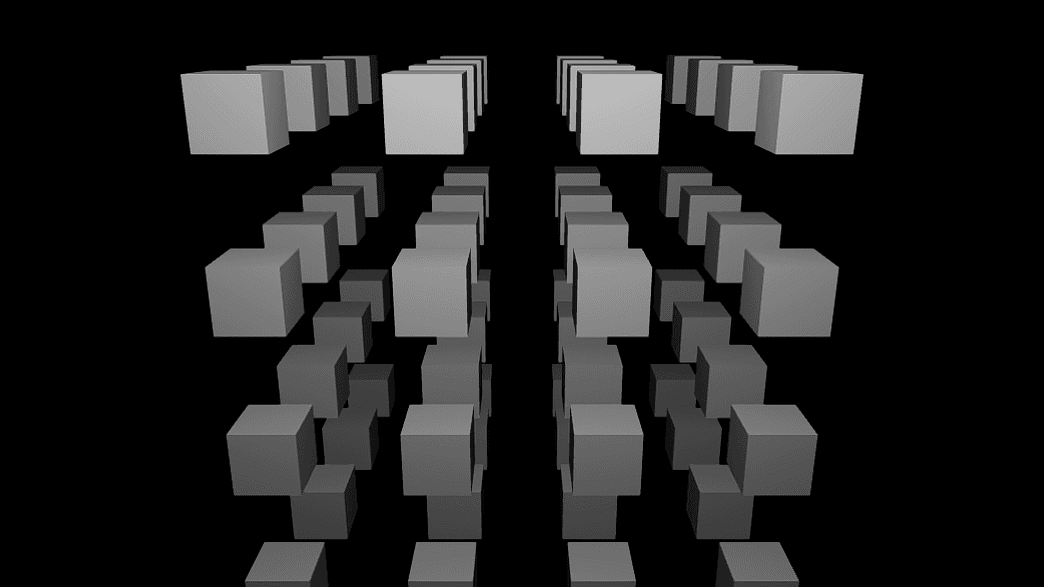
- Reports the resulting Vertices count on the node
- Carries the standard transform block for the merged result
- Found in the node graph under Surfaces → Geometry; search for
bakeorflatten
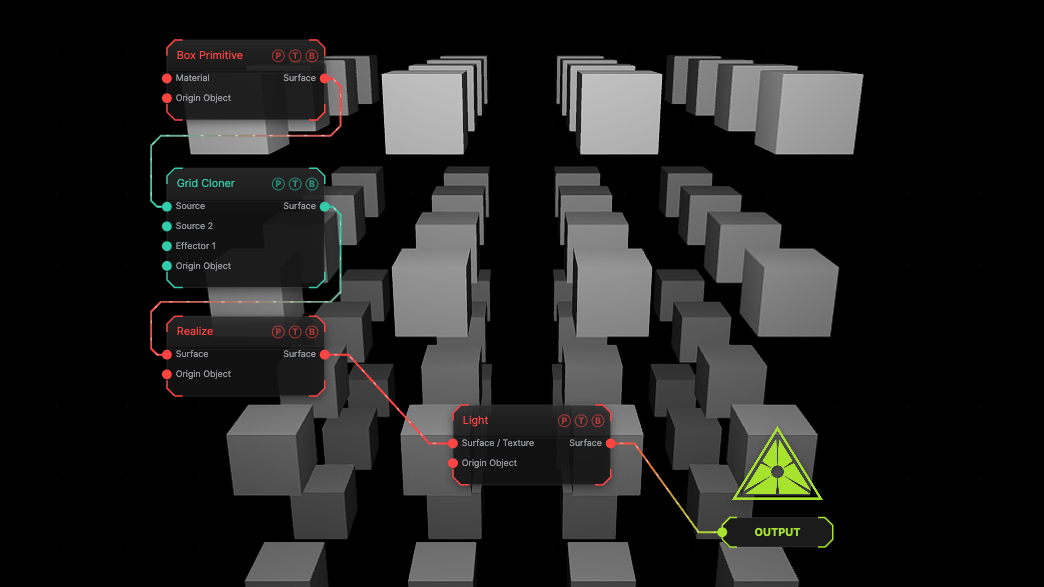
The image on the right is the example patch itself. Drag and drop it onto the app, or load it with File → Load, to open the full graph. A 4×4×4 Grid Cloner of small boxes is realized into one mesh.
Inputs and outputs
| Port | Type | Purpose |
|---|---|---|
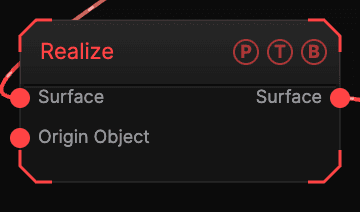
| Surface | Surface | The instanced branch, usually a cloner. |
| Surface | Surface | One mesh containing every instance. |
Parameters
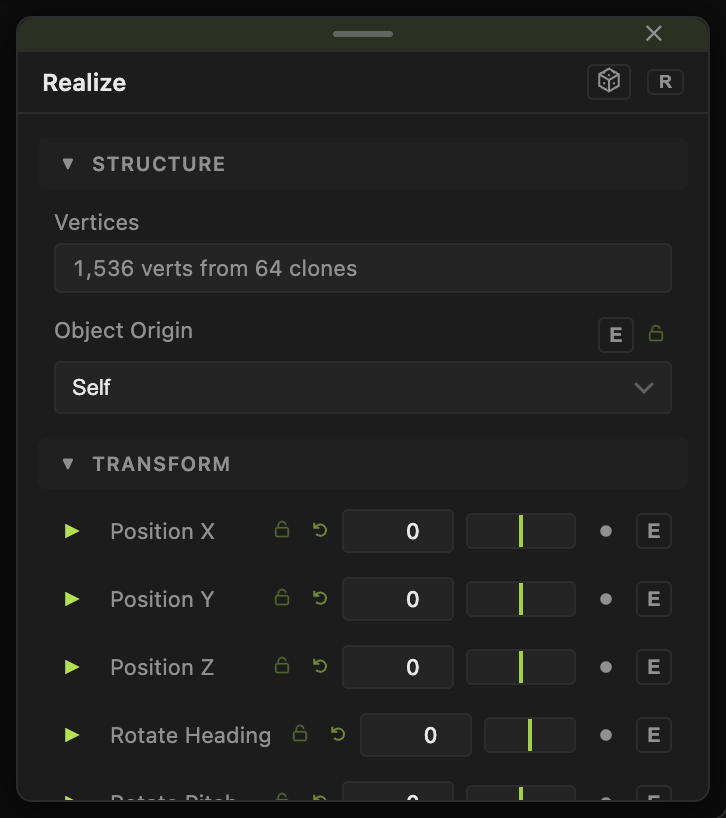
- Position X / Y / Z, Rotate Heading / Pitch / Roll, Scale X / Y / Z, Uniform Scale — placement of the realized mesh.
- Vertices — a read-only count of the merged result.
Cloner effectors still reach the realized array, and a still array stops rebaking, so the cost is paid once per change.
Examples
Cut a whole array — Grid Cloner into Realize, then into a Boolean as the operand. The entire array cuts at once.
Wireframe the array — Realize, then Wireframe, so every instance's edges become tubes in one pass.
Troubleshooting
Effectors stopped animating the array — they still apply, but the mesh rebakes on change. A fast effector animation means a rebake every frame; keep Realize for arrays that move slowly or not at all.